


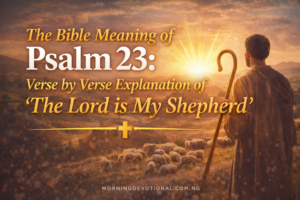
 The Bible Meaning of Psalm 23: Verse by Verse Explanation of “The Lord is My Shepherd”
Few passages of Scripture are as universally loved and recognized as Psalm 23. Whether recited at funerals, sung in worship, or whispered in moments of fear, its opening line—“The Lord is my shepherd; I shall not want”—has brought comfort to millions.
But what is the full Bible meaning of Psalm 23? Is it merely a poem about death, or does it hold deeper truths for daily life?
In this article, we will break down Psalm 23 meaning verse by verse, explore its Old and New Testament context, and reveal why this ancient song remains a lifeline for today’s anxious world.
The Context: Who Wrote Psalm 23 and Why?
Before diving into meaning, we must understand the author. King David wrote Psalm 23. Before becoming king, David spent years as a shepherd in the fields of Bethlehem. When he writes, “The Lord is my shepherd,” he speaks from raw, personal experience.
David knew that sheep are completely dependent on their shepherd for food, water, safety, and guidance. By calling God his shepherd, David confesses total reliance on God—not on his own strength, armies, or wisdom.
Key Insight: The Bible meaning of Psalm 23 begins with surrender. You cannot say “The Lord is my shepherd” without also saying “I am His sheep.”
Verse 1: “The Lord is my shepherd; I shall not want.”
Meaning: This verse establishes the central metaphor of the psalm. A shepherd provides, protects, and leads. If God is your shepherd, every true need is already covered.
The phrase “I shall not want” does not mean you will get everything you desire. Rather, it means you will lack nothing necessary for your spiritual journey, physical survival, or eternal security.
Application: Before worrying about bills, health, or the future, remind yourself: If God is my shepherd, He has already seen my need.
Verse 2: “He makes me lie down in green pastures. He leads me beside still waters.”
Meaning: Green pastures and still waters represent rest and provision. In ancient Israel, sheep would only lie down when they were full and unafraid. A good shepherd clears the field of predators and poisonous plants.
The “still waters” (literally “waters of rest”) contrast with raging rivers. God does not drive His sheep into chaos. He leads them into peaceful, sustainable places.
Application: True rest is not a vacation—it is a gift from the Shepherd. If you are exhausted, anxious, or burned out, this verse promises that God actively makes you rest.
Verse 3: “He restores my soul. He leads me in paths of righteousness for His name’s sake.”
Meaning: To restore the soul means to bring back what was lost—hope, joy, purpose, or moral strength. Sheep can become “cast down” (flipped on their backs, unable to rise). The shepherd must rescue them.
“Paths of righteousness” are not rigid religious rules. They are the right trails that lead to life. God leads you in these paths not because you deserve it, but for His name’s sake—because His character is faithful and good.
Application: If you feel spiritually drained or guilty over past failures, this verse is your promise: God restores, not condemns. He leads, not shames.
Verse 4: “Even though I walk through the valley of the shadow of death, I will fear no evil, for You are with me; Your rod and Your staff, they comfort me.”
Meaning: This is the emotional center of Psalm 23. Notice: it does not say “if you go” but “even though you walk.” Suffering and danger are guaranteed in this life.
The “valley of the shadow of death” represents any dark, threatening season—illness, grief, betrayal, depression, or literal death. But the Shepherd does not abandon His sheep in the valley. He walks through it with them.
The rod (a club for fighting off predators) and staff (a long hook to pull sheep from danger) symbolize God’s protection and discipline. Both bring comfort because they prove the Shepherd is near and active.
Application: You do not need to be brave. You only need to stay close to the Shepherd. His presence is greater than any valley.
Verse 5: “You prepare a table before me in the presence of my enemies; You anoint my head with oil; my cup overflows.”
Meaning: The imagery shifts from shepherd to royal host. Even when enemies surround you, God prepares a feast. In ancient culture, anointing with oil was a sign of honor, refreshment, and divine blessing.
A “cup that overflows” speaks of abundance—not just enough, but more than enough grace, joy, and provision.
Application: You do not have to wait for the battle to end to eat. God’s blessing is available in the middle of your struggle. Your enemies may watch, but they cannot touch what God has anointed.
Verse 6: “Surely goodness and mercy shall follow me all the days of my life, and I shall dwell in the house of the Lord forever.”
Meaning: The Hebrew word for “follow” literally means “to pursue.” Goodness and mercy are not passive—they chase after you like a loyal guard dog.
“Dwell in the house of the Lord” refers to more than heaven. For David, it meant living in God’s presence daily through worship and obedience. For Christians, it points to eternal life with God through Jesus Christ.
Application: Your future is not uncertain. Goodness and mercy are already pursuing you today. And your final destination is not a grave—it is the house of the Lord forever.
4 Powerful Promises of Psalm 23 for Today
Summarizing the Bible meaning of Psalm 23, here are four promises you can claim:
-
Provision – “I shall not want.” (v. 1)
-
Peace – “Still waters… restores my soul.” (v. 2-3)
-
Presence – “You are with me” even in the valley. (v. 4)
-
Permanence – “Goodness and mercy… forever.” (v. 6)
How Jesus Fulfills Psalm 23
For Christians, the ultimate Bible meaning of Psalm 23 is found in Jesus Christ. In John 10:11, Jesus declares: “I am the good shepherd. The good shepherd lays down his life for the sheep.”
David was a shepherd-king who pointed to the true Shepherd-King. Unlike human leaders, Jesus actually died for His sheep. He leads us through the valley of death by walking through it Himself in the resurrection.
Practical takeaway: Every time you pray Psalm 23, remember that Jesus is the Shepherd who not only guides but saves.
How to Pray Psalm 23 (A Simple Guide)
You don’t need to be a theologian to pray this psalm. Try this method:
-
Slowly read the psalm aloud.
-
Pause after each verse and turn it into a prayer. Example: “Lord, You are my Shepherd. Show me where I lack trust in Your provision today.”
-
End with thanksgiving – “Thank You that goodness and mercy are chasing me right now.”
Final Thoughts: Why Psalm 23 Still Matters
In a world of uncertainty, fear, and noise, the Bible meaning of Psalm 23 is radical: You are not alone, and you are not in control—and that is good news.
God is not a distant CEO or a harsh judge. He is a Shepherd who knows your name, leads you to peace, walks with you through darkness, and prepares a future of eternal joy.
Memorize it. Pray it. Live it. And let the Shepherd lead you home.